Poumai people
The Poumai Naga Tribe: Guardians of Ancestral Traditions in Manipur
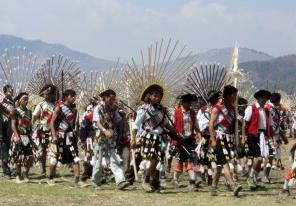
Poumai People
The Poumai, also known as Poumai Naga, are one of the indigenous Naga tribes primarily inhabiting the Senapati district of Manipur, India. They are distinguished by their rich cultural heritage, unique customs, and traditional practices that have been preserved over generations. Their society is traditionally agrarian, with rice cultivation being a primary economic activity.
History and Origin
The Poumai trace their ancestry to the legendary 'Two Brothers' from Makhel village, considered the cradle of the entire Naga race. Oral traditions and folklore are central to their understanding of their past, narrating migrations and the establishment of various villages. Historically, like other Naga tribes, Poumai villages were independent entities, often fortified, and governed by a council of elders. Their history is marked by instances of inter-village conflicts and headhunting, practices that ceased with the advent of Christianity and British administration in the late 19th and early 20th centuries.
Geography and Demography
The Poumai inhabit the northern hills of Manipur, predominantly concentrated in the Senapati district. This region is characterized by rugged terrain, dense forests, and numerous rivers, contributing to a diverse ecosystem. Major Poumai villages include Purul, Oinam, Koide, and Phaibung, among others. According to the 2011 Census of India, the Poumai population was significant within Manipur, although exact tribal population figures can vary based on classification. The dominant religion among the Poumai is Christianity, though elements of their indigenous animistic beliefs and traditions continue to influence their cultural practices.
Language
The Poumai people speak the Poula language, which belongs to the Tibeto-Burman family of languages. It is a distinct language within the Naga linguistic group, although there are dialectal variations across different Poumai villages. Efforts are underway by community leaders and linguists to preserve and promote Poula, especially among the younger generation, through literature and educational initiatives.
Culture and Traditions
Social Structure
Poumai society is traditionally organized around the village unit, with a well-defined social structure. The village council, typically comprising elders and respected individuals, plays a crucial role in governance, dispute resolution, and upholding customary laws. Clans and kinship ties are significant in defining social relations and responsibilities.
Festivals
Festivals are integral to Poumai life, often revolving around agricultural cycles and traditional religious beliefs. Some of their prominent festivals include:
- Omei: A post-harvest festival, typically celebrated with great pomp and traditional dances, feasting, and community gatherings. It is a time for thanksgiving and merry-making.
- Sharkphu/Sharu Pung: An important festival associated with agricultural rituals, community cleaning, and offerings for good harvests and prosperity.
Traditional Attire
Poumai traditional attire is vibrant and distinctive, woven from cotton with intricate patterns and motifs. Men traditionally wear a loincloth, shawl, and headgear adorned with feathers or boar tusks, particularly during festivals. Women wear beautifully woven skirts (pete), shawls, and elaborate bead jewelry. The weaving process is a significant part of their cultural heritage, with designs often carrying symbolic meanings.
Art and Craft
Apart from intricate weaving, the Poumai are skilled in various crafts, including bamboo and cane work, wood carving, and traditional pottery. These crafts are not merely decorative but often serve utilitarian purposes within the household and community. Traditional dances, songs, and oral narratives are also vital forms of artistic expression.
Economic Activities
The primary economic activity of the Poumai is agriculture, with shifting cultivation (jhum) being traditionally practiced alongside settled cultivation of paddy in terraced fields. They also engage in animal husbandry, fishing, and collecting forest produce. In recent times, many have diversified into government services, trade, and other modern professions.
Ecological Significance
The Poumai inhabit an ecologically rich region of the Eastern Himalayas. Their traditional practices, such as jhum cultivation, have evolved to coexist with the natural environment, though modern changes pose new challenges. There is a growing awareness within the community about sustainable resource management and forest conservation, aligning with broader efforts to protect the biodiversity of Manipur.
Frequently asked
Related
Plan Your Journey with Living Roots Expeditions
Travel Northeast India with a private guide, hand-picked hosts, and an itinerary shaped around your interests — culture, wildlife, festivals, or slow discovery. If this subject is why you are travelling, see our tribal tours of Northeast India.