Urgelling Monastery
The quiet, unassuming monastery in Tawang that gave the world the unconventional 6th Dalai Lama, Tsangyang Gyatso.
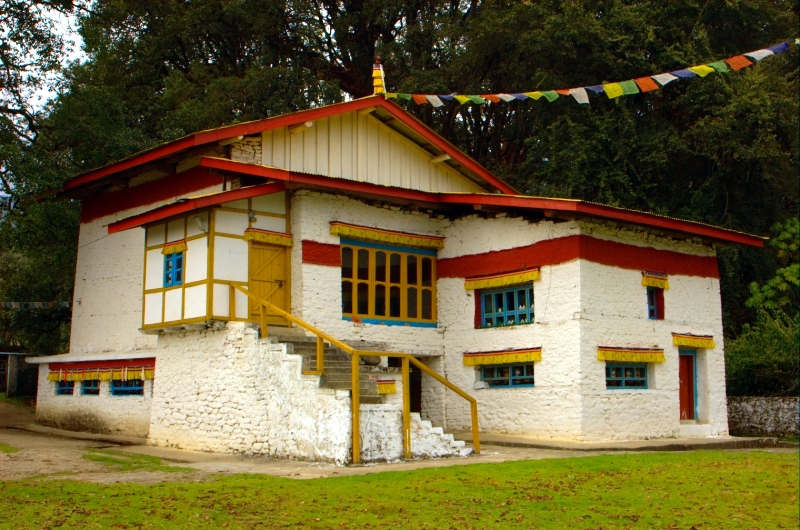
A few kilometres from the bustling centre of Tawang town, a quiet road winds down into a small valley. Here, surrounded by modest homes and fields, sits a structure of immense historical weight but of humble appearance. This is Urgelling, a place that feels less like a major institution and more like a private shrine. Its simplicity is precisely what makes it so profound; this small gompa is the verified birthplace of the 6th Dalai Lama, Tsangyang Gyatso, one of the most remarkable and beloved figures in Tibetan Buddhist history.
History & Context
The monastery's story begins long before the Dalai Lama's birth. It was originally founded in the 15th century (around 1489) by Ugyen Sangpo, a younger brother of the great Bhutanese treasure-revealer, Terton Pema Lingpa. In its first iteration, it was a centre for the Nyingma school of Tibetan Buddhism. Its fate, and its place in world history, was sealed on 1 March 1683 with the birth of a local boy who would be recognized as the reincarnation of the 5th Dalai Lama. This boy, Tsangyang Gyatso, spent his early years here.
Following political turmoil, the original 15th-century monastery was destroyed during conflicts, including the Dzungar-Mongol invasion of Tibet which had spillover effects in the region. For a long time, only ruins remained. The current structure is a more recent construction, built to honour the site's unique legacy. It serves as a reminder of a sacred past rather than as a large, functioning monastic school like its colossal neighbour, Tawang Monastery.
What Makes It Distinctive
Unlike the grand fortress of Tawang Monastery, Urgelling is intimate. Its distinction comes not from architectural grandeur but from its direct, personal connection to the 6th Dalai Lama. He was known for his love of poetry, wine, and song, and for his deeply human, unconventional approach to his spiritual role. Visiting his birthplace offers a unique context for understanding his life and legacy.
The monastery preserves artifacts said to be linked to the Dalai Lama, including sacred footprints and fingerprints. A particularly venerated feature is an old tree in the courtyard, believed to have sprouted from a staff planted by Tsangyang Gyatso himself before he was taken to Lhasa. The atmosphere is quiet and contemplative, offering a stark contrast to the more heavily visited sites in the area. It is a place for reflection on a fascinating historical figure, whose poems of love and loss are still recited today.
Best Time to Visit
March to June (Spring/Summer): The weather is pleasant, with clear days perfect for exploring. Rhododendrons are often in bloom in the wider region, adding colour to the landscape. July to August (Monsoon): Heavy rains can cause landslides and make road travel challenging. This period is best avoided. September to October (Autumn): This is arguably the best time. The monsoon has washed the landscape clean, skies are exceptionally clear offering stunning views of the Himalayas, and the weather is cool and crisp. November to February (Winter): The area experiences heavy snowfall and temperatures drop significantly below freezing. While beautiful, travel can be difficult and many high passes, including Sela Pass, may close intermittently.
How to Reach
Urgelling Monastery is located about 5 km south of Tawang town and is easily accessible by local taxi.
- By Air: The nearest major airport is Lokpriya Gopinath Bordoloi International Airport (GAU) in Guwahati, Assam, approximately 500 km away. From there, it's a 2-3 day journey by road. Tezpur's Salonibari Airport (TEZ) is closer (approx. 390 km) but has fewer flight connections.
- By Rail: The nearest major railway station is in Guwahati. Rangapara North railway station in Assam is another option, located about 385 km from Tawang.
- By Road: From Guwahati, hire a taxi or take a shared vehicle. The route typically involves overnight stops in Bomdila or Dirang. The journey from Guwahati to Tawang takes at least two full days of driving (approx. 15-18 hours) and requires crossing the 13,700 ft Sela Pass.
Permits & Entry
- ILP/PAP: Entry into Arunachal Pradesh is restricted. Indian citizens (excluding residents of Arunachal Pradesh) must obtain an Inner Line Permit (ILP). Foreign nationals must secure a Protected Area Permit (PAP). These can be applied for online or through approved tour operators. Ensure your permit is valid for Tawang district.
- Entry Fee & Timings: Information is not officially published or may change. Visitors are advised to confirm locally before travelling.
Nearby Attractions
- Tawang Monastery (Gaden Namgyal Lhatse): The second-largest monastery in the world, a stunning and active centre of Gelug Buddhism.
- Tawang War Memorial: A moving stupa dedicated to the soldiers of the Indian Army who lost their lives in the 1962 Sino-Indian War.
- Giant Buddha Statue: A large, serene statue overlooking Tawang town and the surrounding valley.
- Sela Pass: The high-altitude pass on the way to Tawang, offering breathtaking views and the sacred Sela Lake.
- Madhuri Lake (Shungestar Tso): A scenic high-altitude lake formed by an earthquake, named after a Bollywood film shot there.
Traveller Tips
- Acclimatize properly in Dirang or Bomdila for a night to avoid altitude sickness before ascending to Tawang.
- Carry sufficient cash. While Tawang has ATMs, their functionality can be unreliable.
- Mobile connectivity is patchy. BSNL and Airtel postpaid services generally work best.
- Dress respectfully when visiting monasteries: cover your shoulders and knees. Remove shoes before entering the prayer hall.
- Always ask for permission before photographing monks or rituals. Photography inside the main shrine is often prohibited.
- Learn a few basic words like "Julley" (general greeting, though more Ladakhi, it's understood) or "Tashi Delek" (a respectful Tibetan greeting).
- The monastery is small and requires less than an hour to visit, but its significance merits a slow, mindful approach.
- Carry a basic medical kit with medicines for headache, stomach upset, and fever.
Frequently asked
Related
Plan Your Journey with Living Roots Expeditions
Travel Northeast India with a private guide, hand-picked hosts, and an itinerary shaped around your interests — culture, wildlife, festivals, or slow discovery. If this subject is why you are travelling, see our Northeast India tour packages.